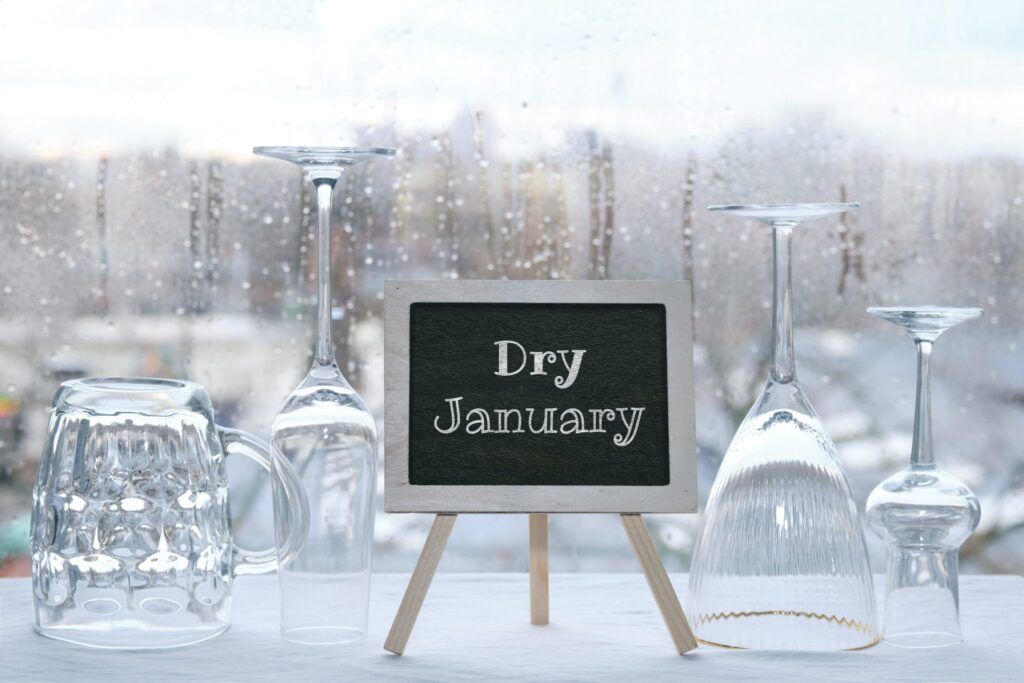
If you’re doing Dry January, there’s a good chance you’re aiming for one (or more) of the following outcomes: better sleep, easier weight loss, less inflammation, improved energy, a reset after the holidays, or simply proof that you could take a break from alcohol if you wanted to. All of that is reasonable — and often achievable.
But before we talk about what to do instead of drinking, there’s an honest conversation that rarely happens — one the medical community frankly owes you. It’s not flashy. It’s not comforting. And it’s definitely not popular. But it is grounded in actual medical evidence, not social media trends or cultural norms.
That conversation starts with this: alcohol is not a neutral substance. It’s not a health food. And it’s not something your body needs — even in small amounts. It is a toxin, full stop. And your body starts detoxing it out of your system the second it enters.
Already, you may be feeling personally attacked. But that’s not what this is. This isn’t about shame. It’s about honesty and clarity.
It’s about viewing Dry January less as a challenge and more as an opportunity: to understand what alcohol actually does to the body, and to decide—intentionally—what role, if any, it should play in your health moving forward.
What the Science Actually Says About Alcohol
In recent years, the World Health Organization (WHO) has taken a much clearer and firmer stance on alcohol and health. In a position statement published in 2023, the WHO stated that there is likely no safe level of alcohol consumption when it comes to overall health risk.
Key points:
- Alcohol (ethanol) is a known carcinogen – we know it causes cancer, including breast and colorectal cancer.It is classified in the same category as tobacco and asbestos by the International Agency for Research on Cancer.
- The risk of cancer begins with the first drink.
- The harm comes from the ethanol itself — not just “excessive” or binge drinking.
This does not mean that a single drink guarantees disease. But it does mean that alcohol, biologically speaking, is a net negative for health, even at low levels.
That’s an uncomfortable truth — and one the medical community has historically done a poor job communicating.
“Moderate” Drinking vs. Drinking “In Moderation”
This is where most people get unintentionally misled — and where language really matters.
Many patients are unknowingly conflating two very different ideas:
- “Moderate drinking” — a medical classification
- Drinking “in moderation” — a vague, aspirational phrase we apply loosely to food and lifestyle choices
Medically, moderate drinking has long been defined as:
- Up to 7 drinks per week for women
- Up to 14 drinks per week for men
That definition places moderate drinking squarely in the middle — not light drinking, not heavy drinking, but regular, consistent intake.
“In moderation,” on the other hand, is how we talk about butter or a slice of cake. It implies something occasional and infrequent. The problem is that many people believe they’re drinking “in moderation” when in reality they’re drinking at a moderate, medically defined level — which is very different.
This is how the nightly glass of wine, cocktail, or beer starts to feel like “being good.” It feels responsible. It feels restrained.
But nightly or weekend alcohol use isn’t occasional — it isn’t “in moderation.” It’s regular intake, full stop, even if it’s “just one glass.” Frequency matters. The body experiences cumulative exposure, not intentions.
If we’re being honest, true moderation with alcohol — in the everyday sense of the word — is probably closer to quarterly or once a month use. It is almost certainly not weekly consumption, and especially not daily. That may be an unpopular opinion, but it aligns far more closely with what we know about alcohol’s cumulative health effects.
The Problem With Math: Applying Alcohol Intake to Real Life
If a woman has one drink 6 nights a week, but two drinks on night 7, she’s already exceeded the “magical” 7-drinks-a-week threshold. One dinner out, one social event — and suddenly she’s crossed into what is technically labeled “heavy” drinking at 8 drinks per week.
Let that sink in.
We somehow treat 7 drinks per week as “reasonable” or “safe,” but become alarmed at 8 drinks per week, even though the difference is literally one drink. That’s not a meaningful biological shift — it’s a mathematical line that had to be drawn somewhere.
And here’s the uncomfortable truth: 7 isn’t benign just because it’s under the cutoff. It likely carries many of the same concerns as 8. The medical community gives 7 a pass not because it’s completely safe and risk-free, but because classifications require boundaries. But that doesn’t make those boundaries completely protective, unfortunately.
The ultimate message here is this: less is better. And this is where I often use a comparison that’s admittedly a bity brazen, but intentionally so — it gets people thinking.
- Do you think I recommend patients limit their cigarette use to 7 per week?
- How often do you think I suggest eating lead paint chips?
It’s not a perfect comparison, but it highlights how differently we treat alcohol compared to other substances with known health harms — largely because alcohol is socially accepted.
And to be clear: this isn’t a moral judgment. It’s a reality check. Anything you do with consistency becomes part of your health equation, whether you intend it to or not.
Consistency Is Key — For Better or Worse
Try flipping the script. Think about a positive health habit:
- Working out
- Taking vitamins
- Hitting your protein goal
If you did any of those things daily or most days of the week, you wouldn’t minimize it. You’d own it.
You might say:
- “I work out five days a week, rain or shine.”
- “I take my vitamins religiously.”
- “I get my protein in every day, that’s just who I am.”
The things you do consistently become your routine. Routine becomes habit. Habit forms identity. And this is how, consistency defines identity.
But when it comes to alcohol, people often downplay the same frequency:
“It’s just one glass.”
“Only on weekends.”
Yet the effects of alcohol compound the same way exercise, protein, sleep, and habits do.
And here’s the part I can say confidently, even without knowing you personally:
If you’re a nightly or near-nightly drinker, it’s probably holding you back — not just with weight, but with sleep, energy, mood, cravings, and overall metabolic health.
That’s not a judgment.
It’s an observation grounded in physiology and repetition.
Does This Mean Alcohol Has to Be Zero Forever?
Hard no.
This is a deeply personal choice, and Dry January is not a lifetime commitment. But anything done daily or near-daily deserves a closer look — including:
- Weekend-only drinking
- Drinking 3 times per week
- “Just a glass to relax” most nights
The real question isn’t: Am I a weak-willed or irresponsible person for drinking?
It’s:
Is this habit helping my goals — or quietly working against them?
From a metabolic and weight standpoint alone, I routinely see:
- Improved sleep
- Reduced inflammation
- Less snacking
- Noticeable fat loss
…in as little as 10 days without alcohol.
And that’s before we even talk about long-term disease risk. Eye-opening, isn’t it?
The Real Work of Dry January
Here’s the part most people miss: we don’t break habits — we replace them.
For many people, alcohol isn’t really about the drink itself. It’s about what it provides:
- A signal that the day is over
- A way to wind down
- A tool for quieting a busy, overstimulated brain
- Socialization with friends or family
If alcohol has been your primary wind-down or socialization tool, removing it — without replacing the function it served — almost guarantees it will show back up on February 1st.
That’s not a willpower failure. That’s a systems problem.
Willpower is unreliable. Systems are not.
Dry January works best when it’s treated as a trial period, not a punishment. This is your opportunity to experiment — not just with how to relax, but with how to connect, unwind, and feel like yourself without defaulting to alcohol.
And no — you don’t need to meditate for an hour, suddenly love the gym, or overhaul your entire personality.
Replacing the Wind-Down (Without White-Knuckling It)
Your nervous system still needs a way to shift gears at the end of the day. The goal isn’t perfection — it’s effectiveness.
Short, real-life options (10–20 minutes):
- Gentle stretching or mobility work
- Guided breathing or meditation (apps count)
- Sipping herbal tea
- A short walk — even if the weather isn’t ideal
Mind + body resets:
- Light resistance training
- Progressive muscle relaxation
- Journaling to “close out” the day
Low-effort, high-comfort options
- Reading fiction
- A favorite podcast or audiobook
- Calming music
- Puzzles, coloring, or hands-on hobbies
- Sitting with a pet or calling a supportive friend
Some days you won’t have time for a workout. Some days the walk won’t happen. Some days you won’t feel like reading.
That’s exactly why you need options, not a single replacement.
Replacing Alcohol in Social Settings
This piece often gets overlooked — and it matters just as much.
Alcohol often acts as a social lubricant, a way to signal belonging (“everyone else has a drink in their hand”), a shortcut to feeling more at ease with others, or sometimes even the social activity itself! Removing alcohol shouldn’t mean removing connection — but it does require intention.
Helpful strategies to try:
- Holding a drink that still feels social (sparkling water with a lime, mocktails)
- Suggesting gatherings that aren’t centered on alcohol (walks, coffee, making dinner, hit the gym, start a book club, try out the climbing gym, join a recreational sports league)
- Letting people know you’re experimenting — not “quitting forever”
- Giving yourself permission to leave earlier if needed
- Practicing social comfort without alcohol (this does get easier with repetition)
This is exactly what Dry January is for — trying things on.
You’re allowed to use tools to calm your brain and support social connection. You don’t have to white-knuckle this. But it is your job to identify what actually works for you — so alcohol isn’t the only button you know how to press.
Because when February comes around, having a system in place matters far more than having “strong willpower.”
What About Non-Alcoholic Cocktails and Alternatives?
For some people, alcohol isn’t just about the effect — it’s about the taste, ritual, or experience of a cocktail, beer, or evening drink. And that’s valid.
Non-alcoholic (NA) options can be helpful — if chosen thoughtfully.
One major thing to watch for is sugar. Many NA drinks replace alcohol with large amounts of sugar, which can quickly turn into an out-of-the-frying-pan-and-into-the-fire situation metabolically.
As a general guideline:👉 Aim for ~5 grams of sugar or less per serving whenever possible.
Options that many patients enjoy include:
For those who choose THC-containing beverages, Cycling Frog is a commonly liked option.
If what you miss is beer specifically, Suntory All-Free may come closest to the experience you’re looking for.
As with all of these:
- Read labels
- Watch added ingredients
- Be mindful of frequency and quantity if sugar or calories are high
These aren’t a free-for-all — they’re tools. And when used with purpose, they can be the difference between “getting through” Dry January and building something that sticks.
An Important Note On True Alcohol Dependence
Alcohol dependence exists — and just like everything else we’ve discussed, it is not a judgment.
Brain chemistry is real. Genetics are real. Past trauma is real. Repetition rewires neural pathways. Dependence on a substance falls on a spectrum, and alcohol is no exception.
If you’ve tried to reduce your alcohol intake and found it much harder than you expected, that doesn’t mean you’re weak or lacking discipline. It means your brain has adapted — and there is help on the other side of that realization.
For many people, the first step is simply an honest conversation with:
- A primary care provider
- A mental health professional
- Or another trusted clinician who can help connect you with appropriate resources and support
While treating alcohol dependence is not our specialty, we hold respect, understanding, and compassion for people at every point on the alcohol-use continuum.
No one deserves shame for how their brain learned to cope. Support is out there — you just need to speak up.
Your Choice — Informed, Not Moralized
Alcohol doesn’t have to be zero forever. Even partial reduction — whether that’s a “Moist January” or fewer drinking days overall — still represents meaningful progress and a real step forward for your health.
But once you understand what alcohol is — a known carcinogen, metabolic disruptor, and substance whose effects compound with regular use — you get to decide whether it’s a tool you want to keep using, for what purpose, and how often.
This isn’t a morality call. It’s a health wake-up call.
At the core of health is a simple truth: You are a product of what you do consistently.
Dry January gives you a rare opportunity to zoom out, gather real data about how your body and brain respond without alcohol, and decide — intentionally — what feels like the right balance for you going forward.
That balance likely won’t be zero, and that’s ok.
Your decision simply needs to be one that honors your preferences, lifestyle, and health goals. After all, the best habits are the ones you can actually live with.